Transaction Speed Dynamics in Mobile Live Dealer Play and Prediction Market Strategies
Quinn Wagner · Jul 15, 2026
Transaction Speed Dynamics in Mobile Live Dealer Play and Prediction Market Strategies
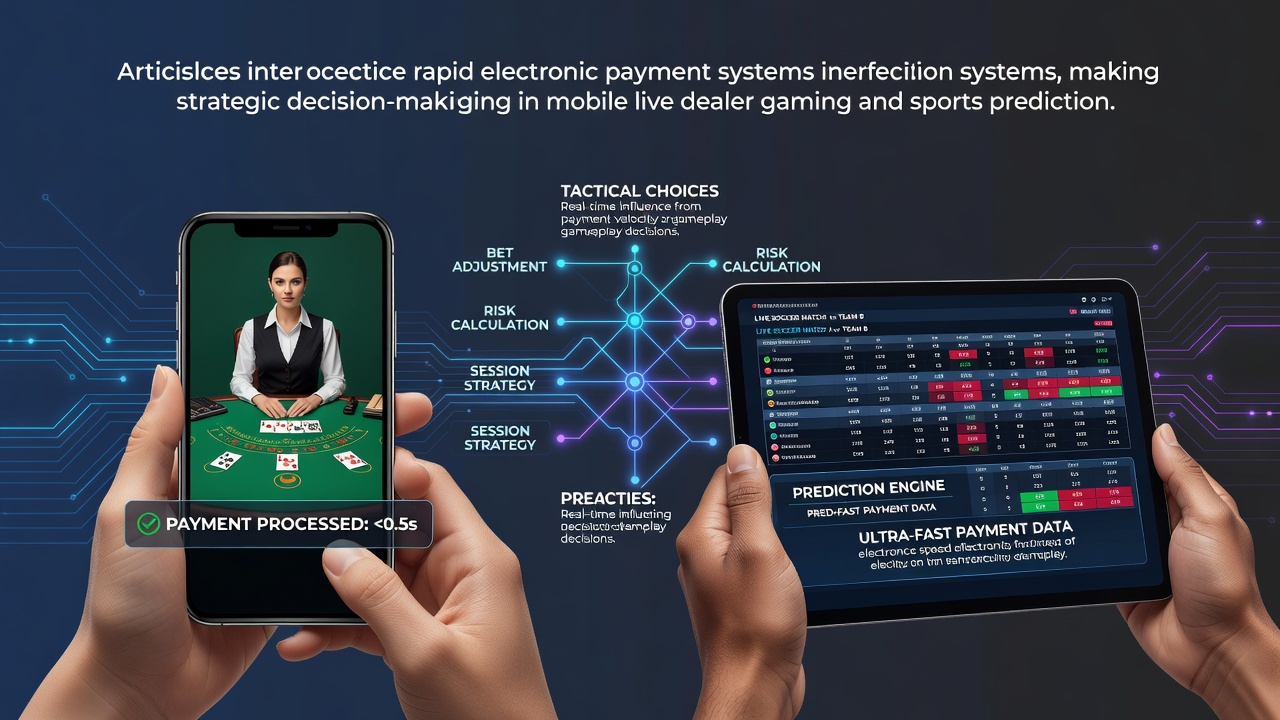
Payment processing velocity has become a measurable factor in how participants adjust their approaches during mobile live dealer sessions and sports prediction activities, where transaction confirmation times directly affect the window available for placing wagers or reallocating positions. Data from industry monitoring services indicate that average deposit completion intervals dropped below three seconds on many platforms by mid-2026, allowing users to respond to changing table conditions or live odds without the delays that once interrupted momentum.Payment Latency and Live Dealer Decision Windows
Live dealer environments require participants to evaluate card distributions, dealer tendencies, and betting patterns within compressed timeframes, and electronic payment speeds determine whether additional funds can enter play before the next round begins. Observers tracking platform metrics note that systems capable of instant wallet-to-wallet transfers enable users to top up balances mid-session, supporting continued participation at tables where minimum bets have increased after initial rounds. Research from European monitoring groups shows that platforms integrating faster payment rails recorded higher average session lengths in the first half of 2026, particularly in blackjack and roulette formats where consecutive decisions accumulate quickly.
Those who monitor player behavior report that slower confirmation times correlate with more conservative initial stake sizing, because participants cannot reliably replenish balances before dealer actions resume. In contrast, sub-second processing allows for incremental adjustments, such as increasing exposure after a favorable run without pausing to complete separate funding steps. Figures released by the European Gaming and Betting Association highlight that regions with widespread adoption of instant payment schemes experienced measurable shifts in average bet frequency during live dealer hours.
Real-Time Reallocation in Sports Prediction Markets
Sports prediction activities, especially those involving in-play adjustments, rely on payment speed to support rapid position changes when new information emerges during events. Participants using mobile interfaces can reallocate exposure across multiple outcomes provided the funding mechanism confirms within the same timeframe as score updates or injury reports. Data collected through industry analytics platforms reveal that markets featuring near-instant settlement options saw increased volume in live propositions during major tournaments in July 2026, when several high-profile matches featured late momentum swings.
Platforms that integrate direct bank transfers or digital wallet solutions with minimal latency permit users to move between prediction contracts without exiting the active interface. This capability becomes relevant when odds adjust rapidly, because the interval between a new data point and the next available wager determines whether a revised position can still be established at favorable terms. Reports from Canadian financial oversight bodies indicate that payment rails supporting real-time authorization reduced the incidence of missed opportunities during peak event windows.

Platform Architecture and Tactical Adaptation Patterns
Payment infrastructure influences the tactical layer because it shapes the feasible range of responses available at any moment. Systems that batch authorizations or require additional verification steps create natural pauses that encourage pre-planned stake sequences rather than reactive adjustments. Conversely, architectures emphasizing continuous connectivity allow participants to treat each confirmation as an extension of the decision cycle, particularly in environments where multiple tables or prediction lines operate simultaneously.
Analyses conducted by research teams at several North American universities documented that users exposed to variable payment speeds developed distinct allocation habits, with faster environments producing more frequent micro-adjustments across sessions. These patterns emerged consistently across both live dealer sequences and sports prediction interfaces, suggesting that transaction velocity functions as an independent variable in strategy formation rather than a background technical detail.
Regulatory Context and Infrastructure Variations
Differences in national payment regulations create uneven playing fields for transaction speed, as jurisdictions with mandated instant settlement requirements enable tighter integration between funding and gaming interfaces. In July 2026, several markets updated their digital payment frameworks to accommodate higher volumes of low-value transfers, directly affecting how mobile platforms sequence authorization requests. These updates produced measurable differences in average response times between regions, which in turn influenced the types of tactical choices observed in cross-border user cohorts.
Payment providers operating under frameworks that prioritize security alongside speed have introduced layered confirmation methods that still complete within acceptable windows for live environments. The result is a technical environment where participants can maintain engagement across dealer rotations and prediction updates without encountering artificial bottlenecks imposed by slower rails.
Conclusion
Electronic payment speeds function as a structural element that shapes the tactical options available in mobile live dealer sessions and sports prediction activities. Faster confirmation intervals expand the set of feasible responses during active play, while slower processing encourages advance planning and more static positioning. Data gathered through 2026 demonstrate consistent correlations between transaction velocity and observed behavior patterns, indicating that infrastructure performance remains a relevant factor in how these activities unfold on mobile platforms.